Prep Ahead Breakfast Recipe: Five-Grain Oatmeal
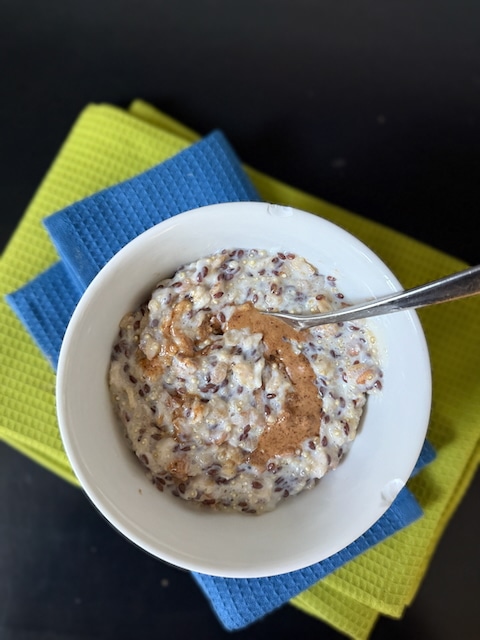

Hungry for a new prep ahead breakfast recipe? Ready to switch up your breakfast routine of toast and peanut butter, this recipe for a Five Grain Oatmeal is for you!
This recipe was inspired by a recent trip to the Bulk Barn, a room filled with bulk bins of grains, flours, nuts, seeds, dried fruits, spices, as well as baking ingredients, salty snacks, chocolates and candies!!
The benefit of trying new foods from a bulk bin is that you can purchase only the amount you need instead of being “committed” to an entire bag of a new ingredient that you aren’t even sure you will like. No more wasted food!
What I love about this recipe is that it allows me to add in different grains and therefore more “plants” in my diet in one meal! Eating a diversity of “plants”, and therefore fiber, is something that research finds is good for our gut microbiome and our total health profile (Farrow et al, 2023)..
What is fiber?
Fiber is a kind of carbohydrate found in foods that come from plants. Fiber does not get digested or absorbed by the body and so it does not increase our blood sugars, like other forms of carbohydrates do.
Fiber-rich foods are plants, including whole grains, nuts, seeds, legumes, veggies and fruits. Including 75% of your meal from these “plants” helps to give our bodies the amount of fiber it needs to thrive.
Fiber is not just about pooping!
Including fiber-rich foods into our meals (and planned snacks) can help reduce constipation. But fiber can also help:
- Reduce diarrhea!
- Feel full and satisfied for longer.
- Slow the rate of digestion and lower the impact of carbohydrates on our blood sugars after a meal. This means that you feel full for longer and reduces our hunger between meals.
- Reduce the risk of developing some cancers.
- Lower our cholesterol.
There are all kinds of life-giving health benefits to including fiber-rich foods as part of our overall dietary pattern. Some of these benefits you can experience right away!
Types of fiber-rich whole grains used in this Prep Ahead Breakfast Recipe
This tasty recipe uses fiber-rich whole grains, which are an important part of healthful eating. Whole grains include all parts of the grain, including the bran, the germ and the endosperm.
When we refine a grain, we remove the bran and germ layers, leaving us with the endosperm component, the part of the grain with just pure carbohydrate. Research has found that eating more whole grains is associated with better blood sugar balance, reduced risk of cancer, liver disease, longer healthspan, reduced risk of cognitive decline, reduced risk of unintentional weight gain. Whole grains help with satiety, “regularity” and are an important source of essential nutrients. For more information on this research, click here. .
Oats:
Oats are a type of whole grain, often cooked with water to make hot oatmeal or combined with milk to make an overnight oat. Oatmeal can be enjoyed as a sweeter breakfast with fruit. It can also be enjoyed as a savoury meal when cooked with vegetable broth and served with cooked vegetables like mushrooms.
Oats are high in something called beta-glucan, a substance that helps to slow the rise of our blood sugars (and so prevents the blood sugar spike-crash-crave cycle) and can help reduce our cholesterol levels.
Oats do not inherently contain gluten, but during processing it is often contaminated with gluten. You can get gluten-free oats if necessary, as is the case when there is a diagnosis of celiac disease.
Barley:
Barley is a type of ancient grain, often added to soup or stew. Barley has so much to offer us! Barley is also high in beta glucan, a substance that may help reduce cholesterol as well as slow the rise of blood sugars in healthy adults. Want to know more about the health benefits of barley? Click here.
You can enjoy barley as a grain that is cooked. Barley can also be ground into barley flour or rolled into barkley flakes, as is used in this recipe. If you are ready to expand how you enjoy barley (beyond just beef and barley soup), click here for recipes from GoBarley.
Barley does contain gluten and so is not suitable for people with celiac.
Spelt:
Spelt is a type of ancient wheat (and so therefore contains gluten, which is only a concern if you have celiac or gluten intolerance). When consumed as a whole grain, spelt will contribute vitamins, minerals and phytonutrients, reduce blood sugar spikes, improve our digestive health and reduce our risk of heart disease.
Spelt can be enjoyed cooked when consumed as spelt berries (like a grain of rice, except made of spelt, which we call spelt berries), ground to make flour or rolled to make rolled spelt.
Quinoa
Quinoa is a gluten-free pseudo-grain (and can be consumed by those with celiac). Quinoa can be consumed as a grain – if you can cook rice, you can cook quinoa! Quinoa can also be rolled into a flake and eaten like an oatmeal, as a flour and as a pasta.
Consumption of 20-50 g/day of quinoa may help reduce blood triglycerides (a type of blood fat) and cholesterol (Dietitians of Canada, 2020).
Flax
Flaxseed is a plant-based food that is high in fiber, and omega-3 fats. Flax is available in seeds, oil and as a ground powder. Whole flaxseed can help prevent constipation, diabetes, high cholesterol, and cancer (Brazier et al, 2023).
Flax can be added to smoothies, added to oatmeal or yogurt parfaits. To explore other recipes with flax, you can click here. Here are 10 Tips for Adding Flax to your Diet.
Prep Ahead Breakfast Recipe: Five-Grain Oatmeal
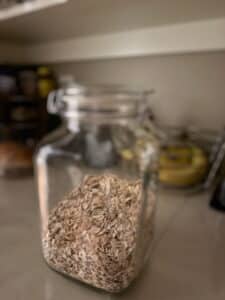
- 2 cups rolled oats
- 2 cups rolled barley
- 2 cups rolled spelt oats
- 1.5 cups quinoa
- 1 cup flax seeds
- Place all ingredients in a sealable container. Stir to combine.
To prepare a batch of this 5-Grain Oat recipe
To prep a fresh batch of this recipe, in a large* glass bowl, combine the following:
- ½ cup 5-Grain Oat Base above
- ¾ cup water
- 1 cup milk
Yield: 2 servings.
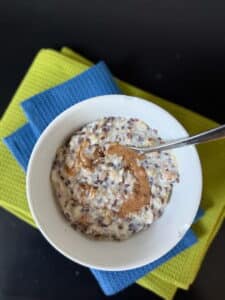
Stir and microwave uncovered for 15 minutes or until liquid is absorbed and is grain is cooked. Serve with a drizzle of nut butter and/or fresh/frozen fruit.
Think of oatmeal like a piece of toast – it is what you put on it that makes it taste extra good! In my blog Does oatmeal have enough protein for breakfast, I share ideas of oatmeal toppers.
*A large glass bowl is needed so that the water and milk do not over-flow and spill over while the oat mixture is cooking.
Alternatively, you can cook this recipe in a medium pot, on the stovetop.
References:
Brazier Y. How healthful is flaxseed? Medical News Today. June 2023. Accessed January 27, 2025. https://www.medicalnewstoday.com/articles/263405
Diabetes Canada. Get the Facts on Fiber. https://www.diabetes.ca/DiabetesCanadaWebsite/media/FilesUploaded/Fibre-Facts.pdf?utm_source=Diabetes+Canada+Email+Subscribers&utm_campaign=7a8dad3342-National_Newsletter_Holiday_2024_Dec_11_24&utm_medium=email&utm_term=0_25457c0fcb-7a8dad3342-223780332&mc_cid=7a8dad3342&mc_eid=0c05f8ceb3
Dietitians of Canada. What are the health benefits associated with consuming ancient grains/seeds (e.g. amaranth, barley, buckwheat, quinoa, sorghum, KAMUT)? Practice-based Evidence in Nutrition. October, 2020, Accessed Jan 27, 2025. Available from:
https://www.pennutrition.com/KnowledgePathway.aspx?kpid=21548&pqcatid=146&pqid=21444
Farrow O, Colavito S, Kolodziejzyk K. Gut Microbiota: Probiotics, Prebiotics & Fermented Foods Evidence Summary. Nov 2023. Available from Dietitian Success Center.
References:
Brazier Y. How healthful is flaxseed? Medical News Today. June 2023. Accessed January 27, 2025. https://www.medicalnewstoday.com/articles/263405
Diabetes Canada. Get the Facts on Fiber. https://www.diabetes.ca/DiabetesCanadaWebsite/media/FilesUploaded/Fibre-Facts.pdf?utm_source=Diabetes+Canada+Email+Subscribers&utm_campaign=7a8dad3342-National_Newsletter_Holiday_2024_Dec_11_24&utm_medium=email&utm_term=0_25457c0fcb-7a8dad3342-223780332&mc_cid=7a8dad3342&mc_eid=0c05f8ceb3
Dietitians of Canada. What are the health benefits associated with consuming ancient grains/seeds (e.g. amaranth, barley, buckwheat, quinoa, sorghum, KAMUT)? Practice-based Evidence in Nutrition. October, 2020, Accessed Jan 27, 2025. Available from:
https://www.pennutrition.com/KnowledgePathway.aspx?kpid=21548&pqcatid=146&pqid=21444
Farrow O, Colavito S, Kolodziejzyk K. Gut Microbiota: Probiotics, Prebiotics & Fermented Foods Evidence Summary. Nov 2023. Available from Dietitian Success Center.
McDonald D, Hyde E, Debelius JW, Morton JT,Gonzalez A, Ackermann G, Aksenov AABehsaz B,Brennan C, Chen Y, DeRight Goldasich L, Dorrestein PCDunn RR, Fahimipour AK, Gaffney J, Gilbert JAGogul G, Green JL, Hugenholtz P, Humphrey G,Huttenhower CJackson MA, Janssen S, Jeste DVJiang L, Kelley ST, Knights DKosciolek T, Ladau J,Leach J, Marotz C, Meleshko D, Melnik AVMetcalf JL,Mohimani H, Montassier ENavas-Molina J, Nguyen TTPeddada S, Pevzner PPollard KS, Rahnavard GRobbins-Pianka A, Sangwan N, Shorenstein J,Smarr LSong SJ, Spector T, Swafford AD, Thackray VG, Thompson LRTripathi A, Vázquez-Baeza Y,Vrbanac A, Wischmeyer PWolfe E, Zhu Q, , Knight R2018.American Gut: an Open Platform for Citizen Science Microbiome Research. Systems3:10.1128/msystems.00031-18. Available from: https://doi.org/10.1128/msystems.00031-18
Tagged in: breakfast, healthy eating, meal planning, midlife nutrition, prep ahead, recipe


Welcome to the Energize Nutrition blog, where we share evidence-based nutrition content, designed to empower people’s midlife. Take a look around to find information on feeling your best.
If you need more individualized support, reach out to set up a free discovery call with Kristyn Hall.

Battling chronic hunger, poor energy, or inflammation? Discover what this powerful ingredient is and why it might be the solution!